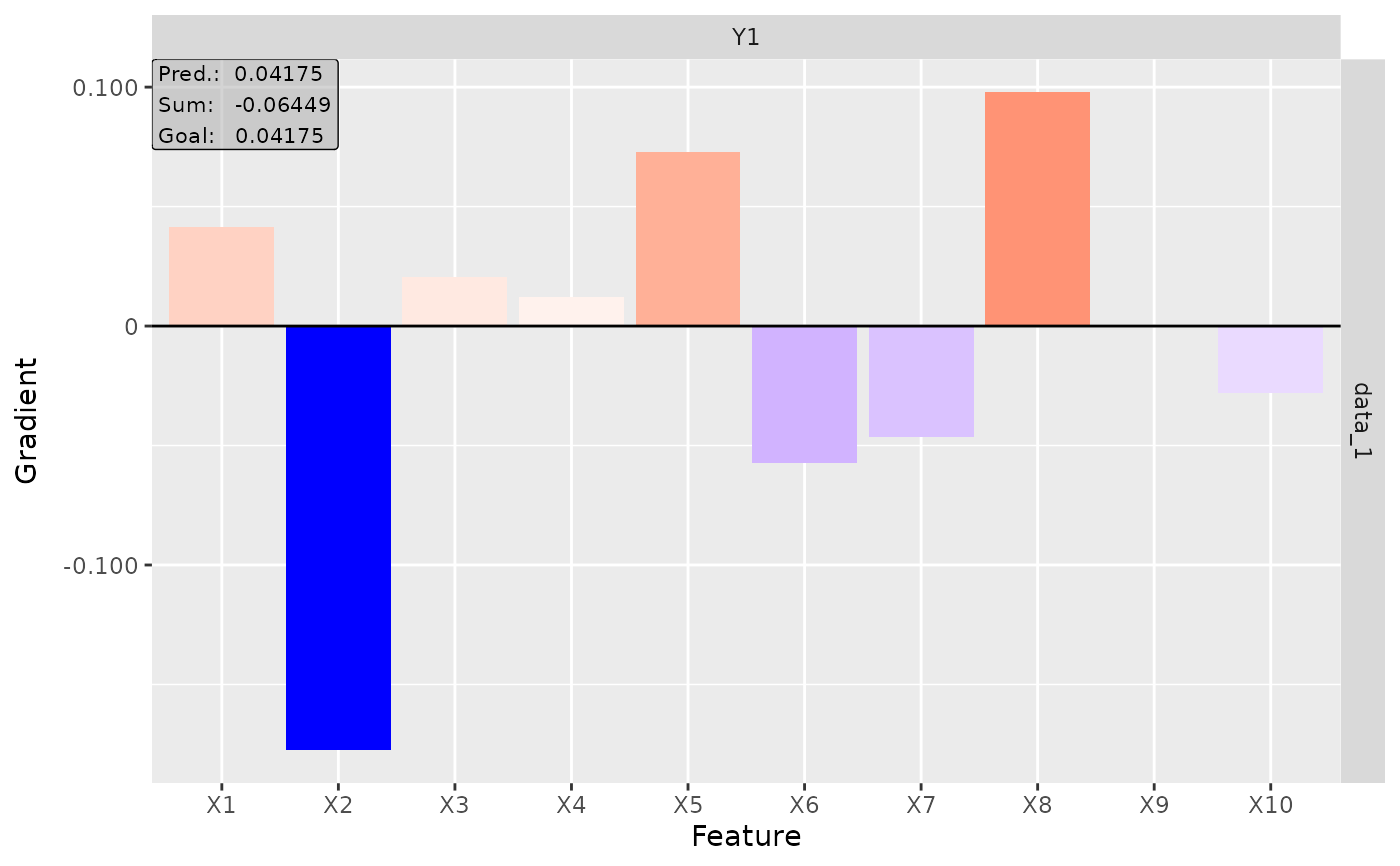
Calculate gradients of model outputs with respect
to inputs using native torch autograd. This function provides a lightweight
alternative to run_grad and Gradient that works
directly with any torch::nn_module objects without requiring model
conversion.
torch_grad(
  model,
  data,
  output_idx = NULL,
  times_input = FALSE,
  dtype = "float",
  return_object = FALSE
)
Arguments
- model
(
nn_module)
A torch model. Must be an instance ofnn_module.- data
(
torch_tensor,array, ormatrix)
Input data for which to calculate gradients. If not already a torch tensor, it will be converted automatically. Expected shape:(batch_size, ...)where...represents the input dimensions.- output_idx
(
integer)
Index or indices of output nodes for which to calculate gradients. If the model outputs a tensor of shape(batch_size, n_outputs), use indices 1 to n_outputs. Default:NULL(all outputs).- times_input
(
logical(1))
IfTRUE, multiplies the gradients by the input values (Gradient×Input method). Default:FALSE(Vanilla Gradient).- dtype
(
character(1))
Data type for calculations. Either"float"fortorch_floator"double"fortorch_double. Default:"float".- return_object
(
logical(1))
IfTRUE, returns aInterpretingMethodobject with methods likeplot()andget_result(). IfFALSE(default), returns a rawtorch_tensor.
Value
If return_object = FALSE (default): A torch_tensor
containing the gradients with shape (batch_size, ..., n_outputs).
If return_object = TRUE: A InterpretingMethod object.
Details
This function computes the gradients of the outputs with respect to the input variables, i.e., for all input variable \(i\) and output class \(j\): $$d f(x)_j / d x_i$$
If times_input = TRUE, the gradients are multiplied by the respective
input value (Gradient×Input):
$$x_i * d f(x)_j / d x_i$$
While vanilla gradients emphasize prediction-sensitive features, Gradient×Input provides a decomposition of the output into feature-wise effects based on the first-order Taylor decomposition.
Performance
This function is typically faster and more memory-efficient than
run_grad because it:
Avoids model conversion overhead
Uses native torch autograd directly
Comparison with run_grad
torch_grad is recommended when:
Working with non-sequential torch models
Working with torch models exclusively
Performance is critical
Use run_grad when:
Working with keras or neuralnet models
You need other attribution methods (LRP, DeepLift, etc.)
See also
Other direct torch methods:
torch_expgrad(),
torch_intgrad(),
torch_smoothgrad()
Examples
library(torch)

# Create a simple model
model <- nn_sequential(
  nn_linear(10, 50),
  nn_relu(),
  nn_linear(50, 3)
)

# Generate some data
data <- torch_randn(5, 10)

# Calculate vanilla gradients
grads <- torch_grad(model, data)

# Calculate Gradient×Input
grads_times_input <- torch_grad(model, data, times_input = TRUE)

# Calculate gradients for specific output
grads_class1 <- torch_grad(model, data, output_idx = 1)

# Get result as innsight object with plot() support
result <- torch_grad(model, data, return_object = TRUE)
plot(result)